The gaming study everyone shared, and what it means for your twelve-year-old
A doctor posted one line about a study. More than 30 million people saw it. I read a thousand of the replies, and the one that mattered wasn’t about the study.

Short answer: one study of 923 adults, average age 55, found that people who game three or more hours a week scored higher than non-gamers on memory, reasoning and processing-speed tests. It can't say the gaming caused that, and no one under 18 was in it, so it tells you nothing about your twelve-year-old. The “13.7 years younger” line came from a 2024 press release that counted gaming differently. I think the better question for a kid is what kind of gaming, and who he plays with.
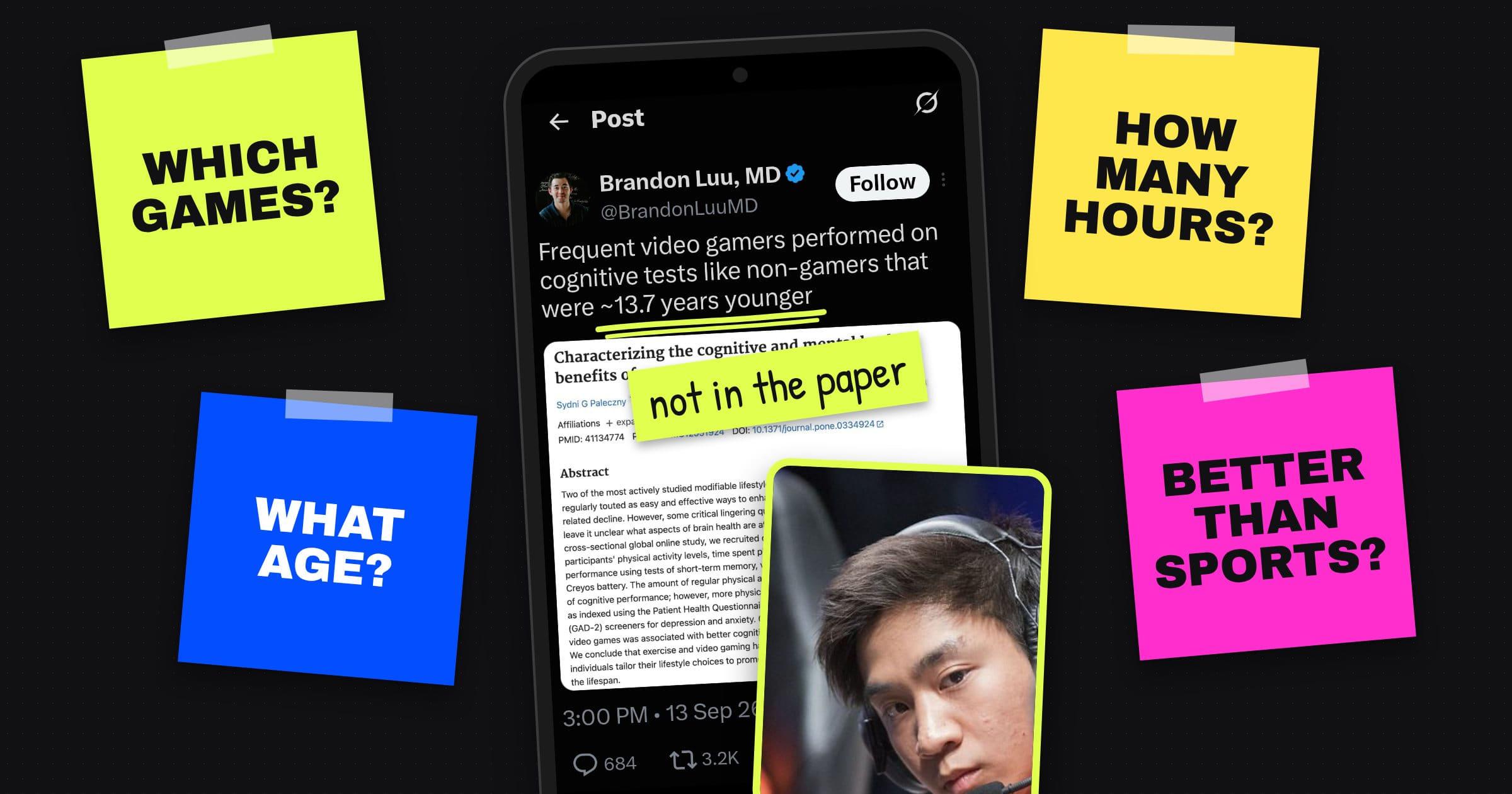
I saw a recent post on X, probably the same way you did. A physician with a big following put up a study abstract and one sentence: frequent gamers performed on cognitive tests like non-gamers about 13.7 years younger. It caught Elon Musk's eye, and he agreed: he quote-posted it with “Gaming ftw.” Counting the posts that quoted it, it passed 30 million views in its first week. For three days my feed argued about whether video games make you smart.
My first reaction was “duh.” My second, after I read the paper, was that the number everyone was repeating isn't in it. The replies were the interesting part.
Why “duh”
I was an introvert with social anxiety bad enough that my mom ordered for me at restaurants. If a stranger talked to me in person, I froze. I was not a good student either. Not because I couldn't do the work; I didn't care about it. My mom tried everything to break me out of it: tennis, piano, orchestra. Nothing took.
The one place I did break out was online. Playing with friends and with randoms, people I'd never have said a word to in a room, because we had the game in common and both wanted to get better at it. I could talk there. I could lead there. No one had to ask me to improve.
In college I made the UT Dallas team and started playing tournaments. A few weeks in, my mom caught me not playing and asked why I wasn't practicing. Like it was the piano. First time an adult treated the game as something you could be good at on purpose. I practiced. Competing paid for a big chunk of college, more than $80,000 in scholarships. That's not the plan for your kid; the scholarships were the receipt. The practicing was the point, and she was right. (I told the longer version of this on camera.)
So, gamers score higher on memory and reasoning tests: yeah. Everything I'm good at, I can trace to a game. But I run a company that coaches kids in one, and a study of 55-year-olds proves nothing about me or your kid. What I can say is that the kid who couldn't order a sandwich learned to run five strangers through a 40-minute match, and the working at it is what changed me. One person.
The reply that mattered
The most-liked reply under the original post was eleven words, and the doctor who posted the study answered “True.”
“The kind of gaming probably matters as much as the hours.”
@CraigBrockie, 1.1K likes when I read it on September 15
That's my whole worldview, from a stranger. Every parent has the hours conversation. Almost none have the “what kind” conversation, because from the couch all games look the same. A kid calling shots for four teammates with a clock running is doing something different from a kid tapping cartoon fruit on a slot machine. What the game asks of him, and who's around him while it does.
What a thousand replies said
I pulled about a thousand replies from the original post and the biggest posts that quoted it, nine threads, and read every one. A second reader checked a sample and disagreed with me one time in five, so call this rough. Four in ten were pro. One in six: “the study's fine, but.” Under one in ten against. The rest: questions, jokes, noise. Three camps, and the words they use. (A fourth, the skeptics, said cross-sectional, self-reported, read the paper. They were right.)
The vindicated, one in six. “A win for gamers.” No one was arguing; they were updating how they felt about themselves. That was me at fourteen, with no one to say it to.
The permission seekers, one in ten. Taking the post straight to whoever had been telling them to stop. My mom didn't have a study. She had a kid on a team, and that turned out to be enough.
The “which games” crowd, one in twelve. StarCraft counts, Candy Crush doesn't. The study couldn't test that; too few action-game players to compare genres. The audience tested it from experience.
“The kind of gaming probably matters as much as the hours.”
“A win for gamers”
“Finally I have a good argument towards my wife.”
“GameCube, Dreamcast and Wii games were built around play itself. Many modern AAA games are built around retention, progression and spending. Both count as gaming, but they may not be doing the same thing to the player.”
The parents who didn't get an answer
I counted about 120 questions: which games, what age, how many hours, is it better than sports. Not one got an answer. The few dozen parents talking about their own kids weren't celebrating. They were asking what I hear on every intake call:
“It may but how do you alleviate the attitude your kid gets when you make them get off of it”
“Kids will quote this study like Scripture. Parents still set the limits.”
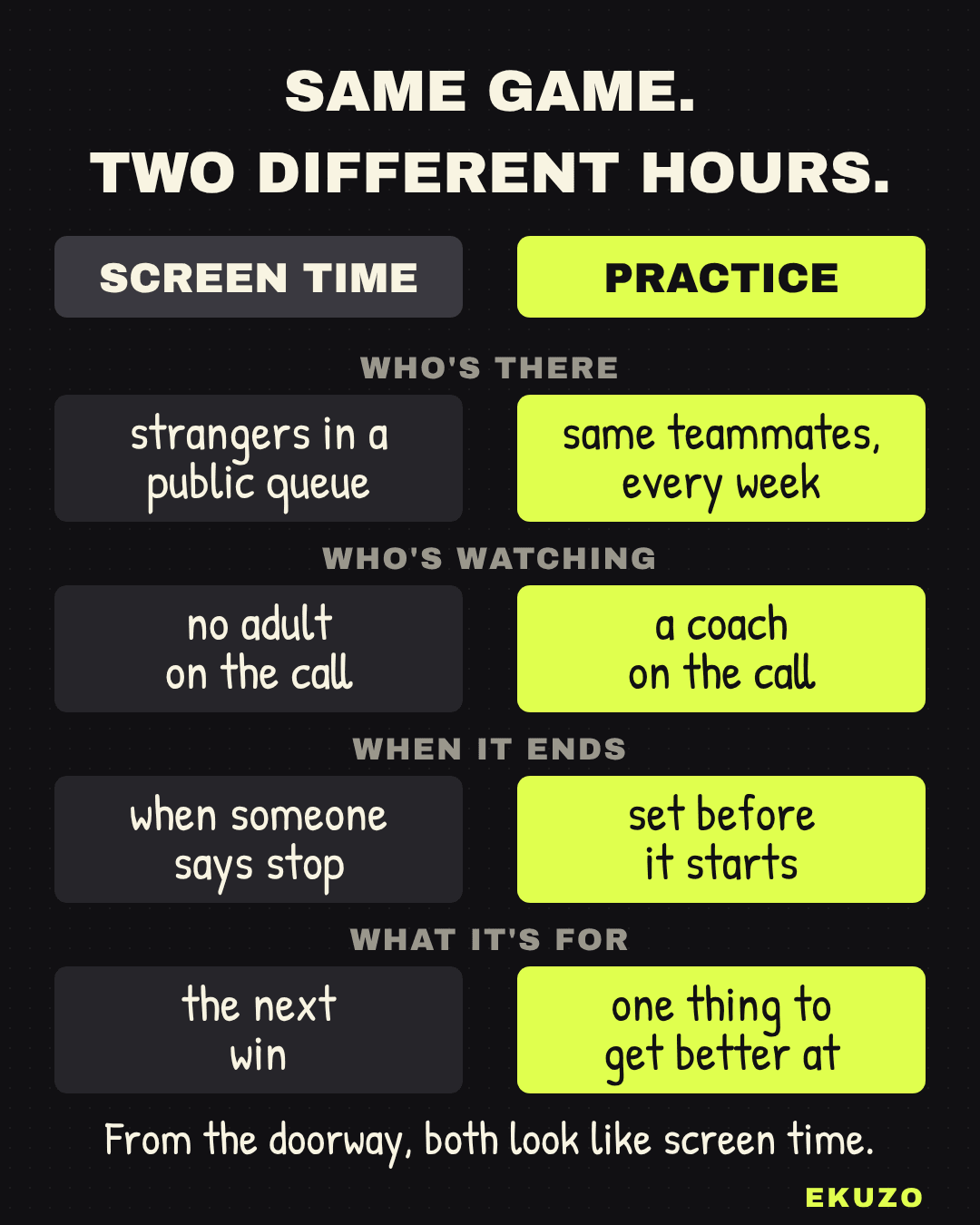
Both correct, and neither is about memory tests. My answer to the first one is how I run a season, not a promise about what comes out. A team that's expecting you on Tuesday. A coach who sets the end of the session before it starts, so getting off is part of the plan instead of a fight at the door. Same game your kid already plays. Everything around it is different.
In June a parent emailed me. Her son, who fences and plays lacrosse and flag football, had to write a sixth-grade entrance essay on his greatest achievement. He wrote about playing mid lane in League of Legends. I won't tell you what that proves. I read it twice.
Karlin on the email that made him cry: a multi-sport kid's greatest achievement was mid lane.
What the study found, and what it didn't
Not my specialty. My read, checked against the paper.
- True. 923 adults, average age 55. Gamers at three-plus hours a week scored higher on memory, reasoning and processing speed; verbal ability, no difference (Paleczny et al. 2025).
- True, and the half no one shared. Gaming had no association with depression or anxiety. Exercise did, and had none with the cognitive scores. That's the half I built around: kids in my sessions do pushups and drink water before ranked.
- True, and why I take it seriously. The senior author ran the 2010 Nature study that found brain-training games don't transfer (Owen et al.). Hard to convince.
- Dubious. “13.7 years younger.” It's from a 2024 press release with a different definition of “frequent”; the paper never converts to years. Do the math on the public data and it depends on the age you compare to: about 15 years at the sample's average age of 55, about 12 at 70, and over 20 at 40, where the study runs out of data. (The script and its output, if you want to check.)
- Needs explanation. Cross-sectional and self-reported: it can't say whether gaming builds the skill or skilled people game more. Volunteers, mostly college-educated. Three of five authors work for Creyos, whose tests were used; disclosed, and Canada's CIHR funded it.
- About kids. Not in this study. The one big study of nine- and ten-year-olds (three-plus hours a day) found somewhat better inhibition and working memory alongside higher attention-problem and depression scores; it was retracted and replaced in 2023, numbers intact, differences “very small” (Chaarani et al.; notice). Anyone quoting the first half without the second is doing the 13.7 thing again.
Where I stop
Time in a game displaces something, and this study measured neither sleep nor what the gaming replaced. A small share of heavy players get into real trouble. Open public queues put your kid next to people and language you would not let in your house. A post that makes you feel better about the hours is not a reason to stop counting them.
So: the study is real, the number isn't the paper's, and a thousand strangers handed a study about hours spent three days talking about which game and who's around him while he plays. That's the conversation worth having at your table this week.
If your kid's version of that conversation is the Fortnite fight, one mom's account of banning it and what came next is the closest thing I have to a field guide. If it's the “which game” question, here's why I coach League. And if you'd rather ask a person, my coaches answer parent questions.
Common questions
Which games did the study look at?
It grouped games by broad type and had too few action-game players to compare genres, so it can't tell you which games.
“The kind of gaming probably matters as much as the hours” is a reasonable working assumption, and it's how I choose what to coach. That's my design choice, not a finding of this study.
Is gaming good for kids' brains?
This study can't answer that; no one under 18 was in it.
The child studies I know of are cross-sectional and mixed: better scores on some tasks alongside higher attention-problem and depression measures in nine- and ten-year-olds, from a paper that was retracted and replaced in 2023 with the numbers intact and the framing changed. “Associated with,” every time.
How many hours is the right amount?
The paper's threshold for “frequent” was three or more hours a week across any game; the press release used five or more on one game. Neither is a recommendation.
The study compared three groups rather than testing a dose, so it can't tell you what happens above its own threshold. The 2026 review by Nagata and colleagues in Current Pediatrics Reports recommends a family media plan and the AAP's five Cs.
Does the study prove gaming beats exercise?
No. Different associations with different outcomes: gaming with the cognitive scores, exercise with the mood screeners, neither with the other. Cross-sectional, so no direction either way.
How do I get my kid off the game without the attitude?
Set the end before the start, and make the ending part of the activity instead of an interruption to it. Teams and coaches do this for sports without anyone thinking about it.
It's the single most useful thing I've borrowed from sports, and the reason my sessions have a schedule a kid can see.
Sources
- Paleczny, Wild, Xue, Highfield and Owen (2025), PLOS ONE 20(10): e0334924. doi 10.1371/journal.pone.0334924. Public dataset (CC0): doi 10.5683/SP3/WUYAGU. Reanalysis: script, output.
- Western University press release, October 17, 2024. news.westernu.ca.
- Owen et al. (2010), “Putting brain training to the test,” Nature 465:775. doi 10.1038/nature09042.
- Chaarani et al. (2022, retracted and replaced 2023), JAMA Network Open. Replacement article; notice of retraction and replacement.
- Nagata et al. (2026), Current Pediatrics Reports 14(1):2, the review recommending a family media plan and the AAP's five Cs.
- The original post and replies: Brandon Luu MD, September 13, 2026, x.com. Reply counts and sentiment are from a read of about 1,000 replies across nine threads on September 14 and 15, 2026; a blind second pass agreed with the stance labels 81% of the time. View counts: more than 30M across the original post and its quote-posts by September 15, 2026. Original post 17.2M as read October 11, 2026; the two largest quote-posts 5.8M and 7.9M, and about 33M across eight posts, as read October 6, 2026. Likes as shown at the time.
Karlin, founder of EKUZO