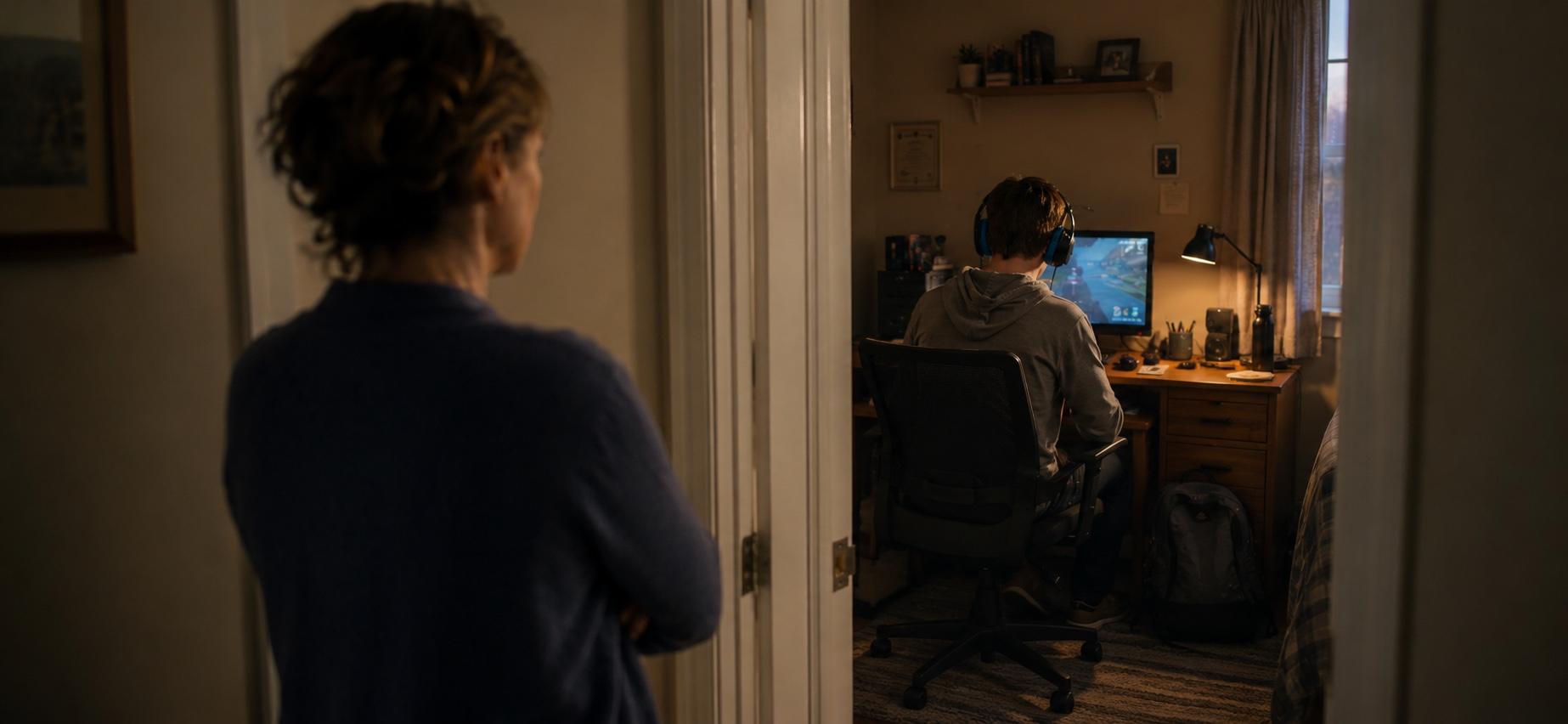
What your kid's gaming is telling you
The game is visible. The meaning is hidden.

Some kids are loud about gaming. They narrate every match at dinner, beg for the new skin, wear the merch to school. You always know where you stand with that kid.
This is about the other kind. The kid who plays just as much and says almost nothing about it. Who gets quiet, or a little embarrassed, when you ask. Who only lights up when someone finally asks the right question.
That gap is more common than it looks. About 85% of teens play video games, but only around 4 in 10 would call themselves a “gamer” (Pew, 2024). A lot of kids play seriously and still won't claim the word. The playing is visible. Whether it matters to them is the part they keep quiet.
Most of the worry about kids and gaming is about volume. How many hours, how late, how to claw some of it back. That's a fair question, but we like to ask what role the game is playing. What it's giving them, what might it be standing in for. By the time gaming is causing friction at home, the game has usually started doing real emotional work in a kid's life, and the hours are downstream of that.
So before you decide what to do about the gaming, it's worth learning how to read it.
The hard parts you notice first
Parents tend to see the rough edges before anything else. The meltdown after a loss. The hours that produce nothing they can describe. The fight about getting off. The friends you've never met. The way they won't admit how much it matters. The frustration of being good and stuck.
Read one way, each of those is a problem. Read another way, each is a clue about what the game is doing for them. Same behaviors, two very different stories.
Here's how we read them.
They get more upset than the moment seems to deserve
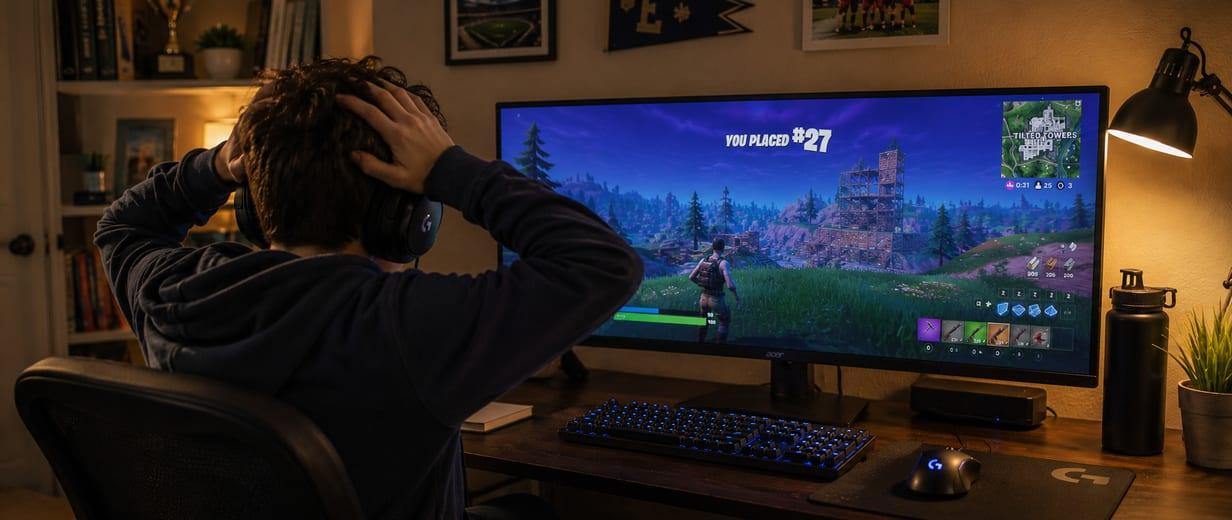
You hear it through the door. A loss, and then a reaction that sounds way bigger than a game. A crashout, if you've heard your kid use the word. Slamming the desk. Snapping at teammates. Or a silence that worries you more than yelling would.
The easy read is that the game is making them angry. Sometimes that's true. More often, the size of the reaction tells you the size of what's riding on it. Somewhere in that game they may have found status, competence, belonging, or a sense of control, and a loss threatens the place where they feel good at something. Researchers have described a version of this loop too: kids who feel anxious or low on confidence may reach for screens to cope, and that can make the game carry even more weight (APA, 2025).
So the useful question isn't “why do they care so much.” It's “what are they carrying into the match.” Then watch what happens after the loss. Can they recover? Can they name one thing that went wrong? Do they blame everyone else, or come back a little calmer? That's the signal worth reading.
They play for hours but can't tell you what they're working on
You ask what they've been doing in there and you get a shrug. 5 hours, and they can't name one thing they were trying to get better at.
It's easy to file that under laziness. But moving fast and getting somewhere aren't the same thing, and from the outside they look identical. A kid grinding for hours has the willpower. What they're missing is anyone who's shown them there's a way to practice at all. The effort's there; it just has nothing to point at.
Watch for whether the interest is in there when you ask the right question. Is there anything they're curious about getting better at, even something small? A kid reaching for improvement with no map will look aimless until the moment someone hands them one. The tell is whether the curiosity shows up at all.
Logging off turns into a fight
I want to be careful here, because sometimes the fight over logging off is exactly what it looks like. Impulse, habit, a brain that wants the next match. That's real and worth taking seriously on its own terms. (It's worth knowing that the researchers who study problem gaming point to the pattern, the conflict, the withdrawal, the loss of other interests, more than to the raw hour count. The clock isn't the whole story.)
Other times, the game was the one place all day that felt active, social, and like it was going somewhere. Leaving it lands like being pulled out of the only room where something was happening. Both can be true in the same kid on different nights.
Watch the shape of the resistance. Is this a kid who can't stop anything, or a kid who's fine putting most things down but goes to war over this one? The first points toward impulse. The second usually points toward meaning. Telling them apart matters more than winning the argument over the clock.
They're social in the game and disconnected outside it
They're laughing with people you've never met, mic on, fully alive in a voice call. Then they come downstairs and barely talk.
It's hard to trust a social world you can't see, especially when all you hear are voices coming through a headset. But the connection is usually real. The large majority of teen gamers play with others, and close to half say they've made a friend through a game (Pew, 2024). The friendships exist. They're just happening in a place with no adults, no continuity, and no reason to carry past the session.
Watch whether any of it survives the game closing. Do these friends have names? Do the same ones show up again, or does the lobby churn every week? Is your kid building something with anyone, or just passing through. A real social thread you can't see is a very different thing from no social thread at all.
They downplay gaming even though it clearly matters
This is the quiet one.
Some kids won't admit how much they care. They call it “just a game,” shrug when you ask, act a little embarrassed it matters to them at all. Usually that's not indifference. It's self-protection. Somewhere they learned that caring about this out loud gets you judged, so they hide the caring to dodge the judgment.
Watch the gap between what they say and what they do. The mouth says “whatever.” The hours, the saved clips, the half-second they light up when someone asks a real question, all say something else. When a kid downplays the thing they pour the most time into, the downplaying is the tell, not the truth.
They're good enough to be frustrated but not supported enough to grow
They're good. Good enough to know when they're playing badly, good enough to be furious about it, and stuck in the same spot for months.
Talent with no feedback has a way of curdling. A kid who can feel they should be improving and can't work out why often starts deciding the problem is everyone else. The blame, the tilt, the sharpness in chat, that's frequently a skilled kid hitting a ceiling alone, not a character turning bad.
Watch whether the frustration points anywhere. Is it “my teammates are trash” on a loop, or is there a flicker of “I don't know what I'm doing wrong” underneath it? The first is frustration protecting itself. The second is a kid asking for coaching without the words for it, and it's easy to miss.
The pattern underneath all six
These look different from the outside. Underneath, they share a shape.
A kid cares about the game. The game is doing real emotional work, carrying status, friendship, competence, and a sense of control. The environment around it isn't built to hold something that meaningful.
That's why the answer is rarely “less gaming” or “more gaming.” Both miss what's going on. What tends to help is a better container around the thing they already care about: a team, a coach, a rhythm to the week, a shared language for what happened in a match, a culture that sets the tone, and a way to lose, learn, and come back. That may be why school esports programs often reach kids who weren't showing up anywhere else. One NASEF-referenced finding put it at roughly 9 in 10 participants not in any other extracurricular. It catches the kid who slipped through everything else.
One caveat I'd stake a lot on. The container only works if the culture inside it is right. Put a coach and a bracket around a toxic, unmoderated mess and all you've done is make the mess official. Who moderates, who's in the voice chat, which games get picked, whether a beginner is allowed to be a beginner: that's what decides whether the structure helps.
Why I keep coming back to this
I'll be straight about where this comes from. I wasn't the parent in this story. I was the kid.
I grew up gaming through social anxiety, low self-esteem, and a complicated relationship with divorced parents. School felt like being made to care about things I didn't, when all I wanted to do was play. My best memories as a kid are playing games with friends.
Nobody around me knew what to do with that. 12-year-old me had no idea what it meant to be on a team, with structure, routine, and intentionality. Even at 18 I was only starting to see that gaming had taught me ownership, accountability, and how to lead. I stumbled into competitive esports in college, it covered more than $80,000 of my education, and my relationship with my mom has never been better. For me, the game wasn't the problem. The missing piece was a container, and I didn't get one until late.
DAY 4 of Karlin's founder series — on what gaming gave him, and what was missing.
One honest note
If your kid's gaming comes with real withdrawal from people, sleep or school falling apart, or a low mood that doesn't lift, talk to a pediatrician or counselor first. A coached team can help a kid grow from something they're invested in. It can't treat what's hurting underneath.
A low-stakes way to test the container
If you read these and thought “that's my kid,” there's a small way to see what changes when the game gets a better container, without betting a season on it.
EKUZO100is our shortest version of that environment. One month, a small team of 5 players at their level, a coach, and a real practice rhythm. Not because every kid should become an esports athlete. Because some kids need a place where the thing they already care about can become social, coached, and healthier. Think of it as an experiment. At the end you're not looking for a pro player. You're looking for a clearer kid: more language for what they're working on, a bit more confidence, more sign that the interest has somewhere good to go.
Questions this article may raise for parents
Is my child's gaming trying to tell me something?
Often, yes.
Gaming can look simple from the outside: they play, they win, they lose, they get loud, they get quiet, they ask for more time. But underneath that behavior, the game may be giving them something important: challenge, progress, identity, friendship, confidence, or a place where they feel capable.
Two things matter: how much they're playing, and what role gaming is playing for them.
Does getting upset during a game mean gaming is unhealthy?
Not automatically.
Sometimes frustration means the game matters. Your child cares about improving, contributing, winning, or not letting teammates down. That emotional investment isn't the problem by itself.
The important question is what happens next.
- Do they recover?
- Do they reflect?
- Do they blame everyone else?
- Do they learn how to handle pressure better over time?
Big feelings are part of competition. In the right environment, those moments can become practice for resilience, communication, and self-control.
Why does my child care so much about a game?
Because games aren't just entertainment for many kids.
They're where kids compete, improve, socialize, express themselves, and feel progress in real time. A game can become a place where your child feels known, skilled, or part of something.
Plenty of gaming environments aren't healthy. The motivation underneath them is still real.
When that motivation is surrounded by structure, coaching, and community, it can become something parents understand and support instead of something everyone argues about.
What should I look for besides screen time?
Screen time matters, but it's not the whole picture.
Look at what surrounds the gaming:
- Is your child playing alone or with people they know?
- Are there expectations around behavior?
- Is anyone helping them improve?
- Are they learning to communicate, recover, and contribute?
- Does gaming create connection, or does it pull them further away?
The same number of hours can mean very different things depending on the environment around them.
When does gaming become a real opportunity?
Gaming becomes an opportunity when it has the same things adults already trust in sports: coaches, teams, practice, expectations, feedback, and healthy competition.
Without that structure, gaming can drift into isolation, toxicity, or endless play.
With structure, it can become social, skill-building, and meaningful. The game stays fun, but the environment around it changes what kids get from the experience.
How can parents support gaming without just giving in?
Start by getting curious. Ask what your child is working on, who they play with, what they're trying to improve, and what makes the game matter to them. Those questions often reveal more than rules alone.
From there, look for structure. Kids do better when gaming has clear boundaries, positive expectations, and adults who understand the space.
The goal is to help gaming become something your child can grow through.
— Karlin, founder of EKUZO
If the viral “13.7 years younger” gaming study is why you're here, that number isn't in the paper. I read about a thousand of the replies and wrote up what it means for a twelve-year-old.