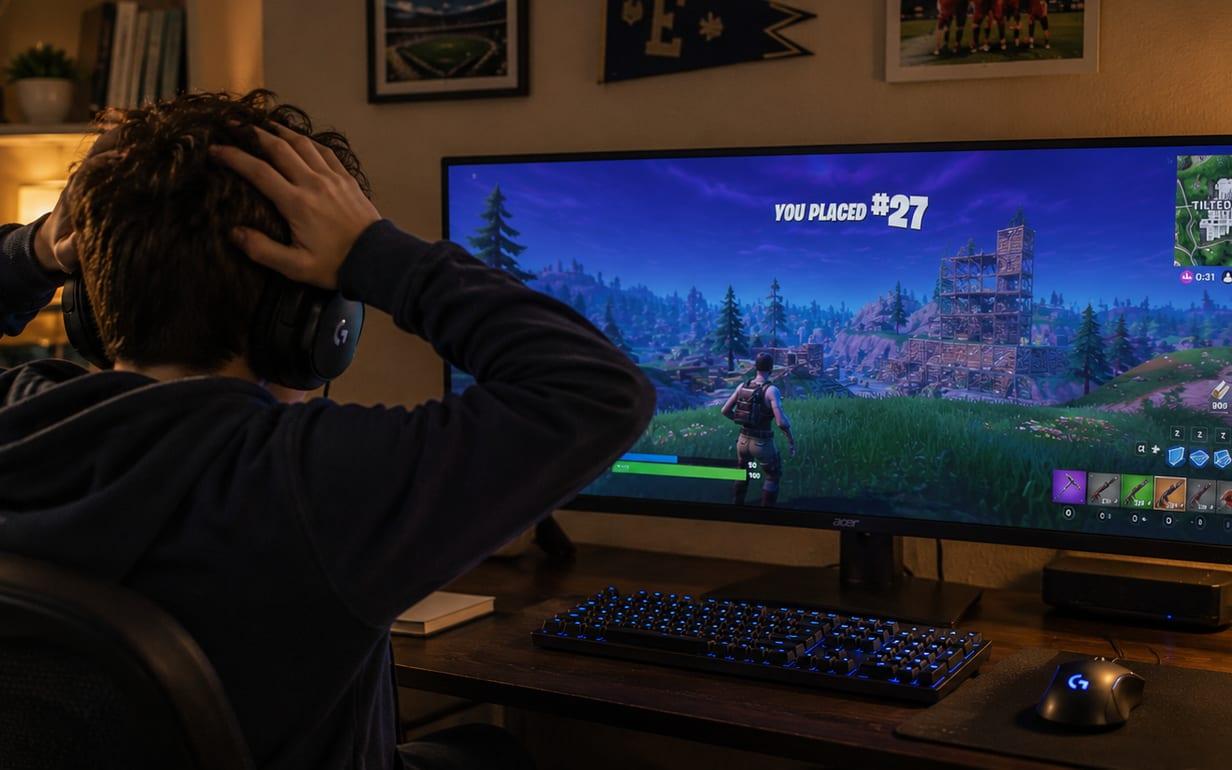
When your son’s only friends are online
Are online gaming friends real? What parents see, and what kids may actually be doing.
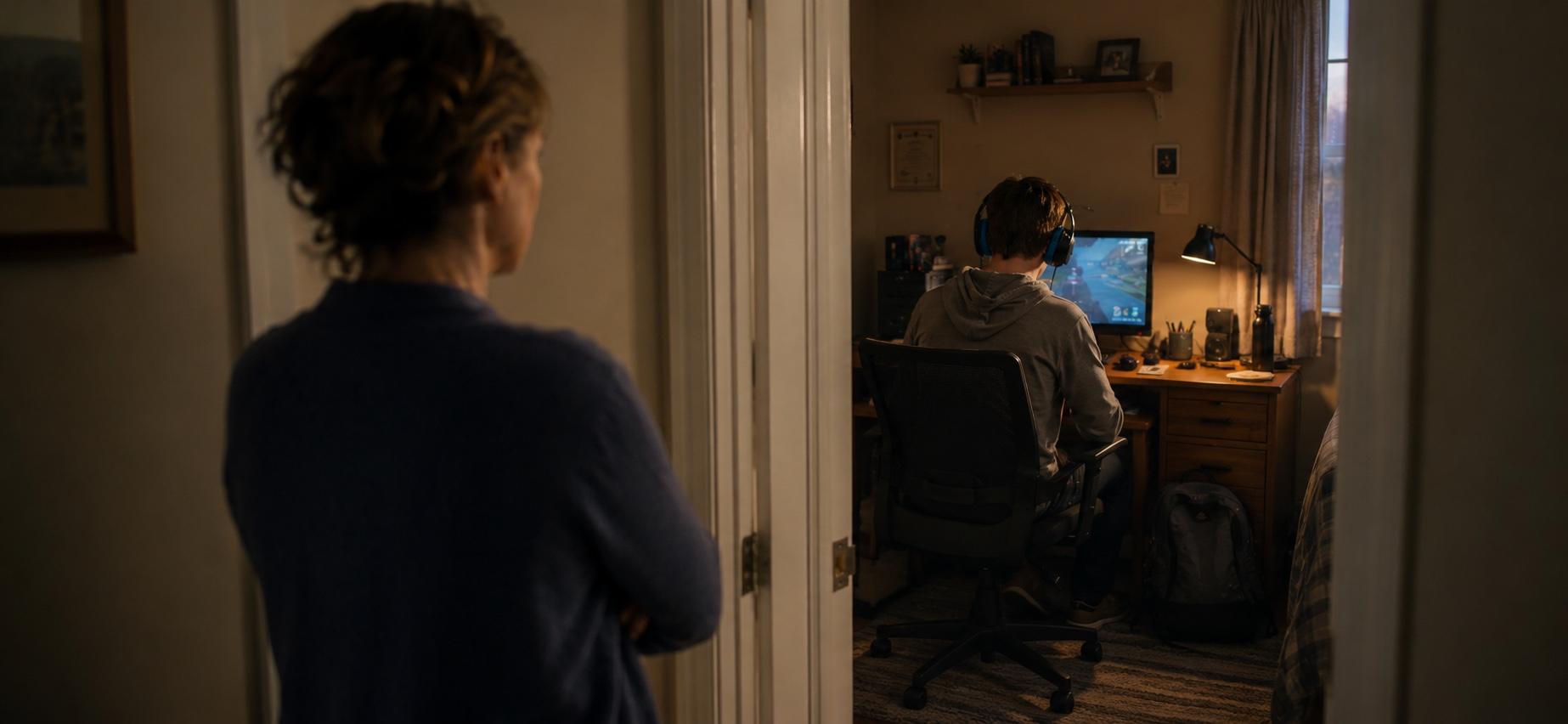

Short answer: if your son spends his nights on a headset, the question worth asking is not how many hours he plays, or even whether his online friends count. It’s whether he’s playing with the same people over time, talking and on a team, or grinding alone in an anonymous lobby. One of those is connection. The other is isolation with a crowd in the background. The screen looks the same from the hallway. What’s happening inside it is not.
What you see, and what he is living
I grew up active. I played sports year-round, took piano lessons, and loved art. But what I loved most was gaming, so much that I often chose it over friends, girls, and other activities. That was more than my parents knew how to handle, since they didn’t grow up with it.
By high school, even though I stayed active in the “traditional” stuff, I was short, socially awkward, and got bullied for it. I found solace in games. More than any other medium, they felt like a pure meritocracy: a level playing field where it was just a test of skill, often against myself, with no judgment attached. I was on a console with dial-up internet, so the solitude was real. My parents saw a kid alone in his room staring at a screen, and they weren’t entirely wrong.
That’s the gap many parents of gamers stand in. From the doorway, you see a kid alone with a screen. Sometimes, like me at 13, that’s exactly what it is. Other times he’s living something real you can’t see from the hallway. The useful move is learning to tell the difference: the kind of gaming that connects versus the kind that isolates, and why.
Is it the screens?
It’s fair to worry about connection right now. In-person time with friends has fallen about 71% for teens since the early 2000s, and boys in particular run short on the close kind: 16% of boys have no friend to turn to for support, against 5% of girls. The easy thing to blame is the screen.
Look closer and the screen is the wrong target. For many kids, gaming is active play: they’re in a match making decisions, talking, adjusting, and reading other people in real time. It’s a different activity from lying on the couch doom scrolling, even though both happen on a screen. And when researchers actually read what kids say to each other mid-game, the social messages (“what’s up,” “you good?”) outnumbered the strategy talk by more than three to one. For a lot of boys, who tend to bond shoulder-to-shoulder around an activity rather than face-to-face, a headset full of teammates isn’t a sad substitute for friendship. It’s how they build it.
So the real question isn’t online versus offline. It’s something else.
The real question: alone or together
Two kids can play the same game for the same hours and end up in opposite places, depending on whether they play alone or with people.
A 2025 study found that adolescents who played only by themselves had a worse sense of their friendships, their family ties, and themselves than kids who played in shared, social settings. And long-term research on boys found that the ones who struggle socially tend to game more afterward, not the other way around. For many kids, heavy solo play is often the symptom, not the cause. The screen is showing you where the need is. The need is connection, and the game is the closest place he found it.
That turns “how many hours is he on” into two better questions. Is he playing with the same people, talking, on something like a team? Or is he alone in a lobby full of strangers who churn through every night? And if the game were gone, what would he reach for instead: passive scrolling or something active? The answers tell you whether to worry, and what to do about it.
The same idea surfaced when the viral “13.7 years younger” gaming study made the rounds (the number isn’t in the paper; Karlin, our founder, read about a thousand of the replies). The most-liked reply under the original post was “The kind of gaming probably matters as much as the hours.”
We have high expectations in real life. Why not this?
Here’s the part that should bother us more than it does. If a kid says they’re going out, you ask who with, when they’ll be home, then bless or push back. “Don’t worry about it” wouldn’t fly. And you’d never drop a kid at an empty field to “play” with friends without asking who’s running it and who else will be there. But online, no structure is the default. An open lobby has no continuity, no shared standards, and often a stream of casual toxicity born out of the environment. Isn’t it interesting that we hold the screen to a lower standard than anything else in our kids’ lives?
In sports, a great team is never really about the game. It’s about the teammates, the shared goals, the coach, and the permission to try, fail, and learn together. It’s the journey, and the memories along the way. It’s a place to live a great shared experience with a scoreboard. The good news is you can look for that same shape around a game. Three features turn solo play into belonging:
- The same people, repeatedly. Continuity is what lets a kid matter to a group.
- A reason to come back. A team, a season, something that expects him next week.
- An adult who is actually in the room. Not a content filter. A person who knows the kids and notices when one goes quiet.
My parents stumbled into a version of this. Instead of restricting my gaming, they offered to fund a computer if I built it myself on a budget. It was completely new to me and it was hard, but at 16 I did it, because I loved gaming that much. The build taught me to make decisions, wire hardware, even how to use a soldering iron. More importantly, it turned my solo habit into something social. PC gaming pulled me into online communities and, eventually, LAN parties in someone’s garage: unlimited Mountain Dew and Doritos, miles of cords we ran by hand, a full night of Counter-Strike. I loved it. I came out of it technically confident and, for the first time, comfortable with people who got my nerdy side and no fear of the cool kids. That leap pointed me toward a STEM career and taught me real lessons in humility and kindness. I don’t know where I’d be without it.
Ryan found his team
One of our moms, Lisa, shared a story that shows exactly how this can work. Her son Ryan was an easy-going, happy kid until sixth grade, when he was bullied from day one and the anxiety wore him down until he was begging to stay home. A new school helped a little, and then a coached League of Legends team changed the shape of things. Ryan was one of the youngest players, learned the game fast, and within his first year his teammates were choosing him to lead them in tournaments. Lisa says she had never seen that kind of confidence from him in t-ball, soccer, or basketball. The way she put it, esports came into his life at just the right time, and the confidence brought the old Ryan back. You can read Ryan’s story in his mom’s words. It’s one family’s experience, not a guarantee, but the shape of it is familiar.
Where a coached team fits
This is the kind of impact we expect from sports and rarely imagine online. That is what EKUZO is: the same shape, built around gaming. We don’t change what your kid loves. We add what an open lobby leaves out: the same small roster each week, a season that gives practice a point, and a coach on the voice channel who knows him by name. Our coaches are collegiate esports players, usually a few years older than the kids they coach, which for a lot of boys matters more than another adult instructing them. They’re close enough to be believable and far enough along to be worth following.
EKUZO runs coached esports teams for kids ages 10 to 17. See the current programs.
What “real friends” actually means
Decades later, my closest friends are still a mix of people I met in person and people I met through a game. Many of the online ones have lasted the longest. Yet while my wife can name every one of my in-person friends, she can’t name a single one of my gaming friends, the ones I’ve talked to online for decades, many living half a world away. That’s not a problem. The friendship is real, it’s just less visible from the outside. That gap, between how real a friendship is and how visible it is, is what you’re looking at when you stand outside your son’s door. Your job isn’t to decide whether the friends in there are real. It’s to make sure he’s holding them to the same standard he’d use anywhere else: good people, like-minded, who add something to his life.
When it is more than this
One honest note. If you have concerns about your son’s gaming that go past a quiet social life and are trying to read the signals, our companion piece on what your kid’s gaming is telling you walks through six of the most common ones. If it’s beyond that: talk of hopelessness, thoughts that he might hurt himself or others, or true withdrawal from everything he once loved, that’s the moment for a doctor or a licensed mental-health professional, not a gaming program. A team can help a lonely kid build belonging. It is not treatment for depression or anxiety, and we’d never pretend otherwise. If you’re unsure, start with your pediatrician.
Common questions
Are online gaming friends real friends?
Often, yes. Most of the talk during gaming is social rather than tactical, teen online and in-person friend groups overlap heavily, and plenty of adults will tell you their longest friendships run through a headset. The friendships can be real, and you can still want them anchored in a steady, supervised group rather than a rotating cast of strangers.
Is gaming isolating my son, or connecting him?
It comes down to one thing: is he playing with the same people over time, talking and on a team, or grinding alone in a lobby of strangers? The same hours can produce opposite outcomes. Solo, anonymous play can track with isolation. Steady, social, supervised play is much more likely to build belonging. Watch the shape of it, not the clock.
How can I help my gamer kid make friends?
Look for three things around the game he already loves: the same people week to week, a reason to come back like a team or a season, and an adult who is actually present. A coached team built around his game is one of the most direct ways to get all three at once. Adding that structure works better than pushing him toward activities he’ll quit.
Should I take the games away?
Usually that removes a lonely kid’s main social outlet and starts a fight that changes nothing. Adding structure works better than subtracting the game. Aim for play that puts him with the same people, around an adult, with a reason to come back.
My son has no friends and only wants to game. Should I worry?
Worry less about the hours and more about the shape. If he’s talking and playing with the same people toward a shared goal, that’s connection happening where he’s comfortable. If he’s alone in an anonymous lobby every night, that’s the signal to help him find a consistent group. Either way, the way kids gather has changed in 20 years, and this says more about the era than your parenting.
Are esports teams good for shy or bullied kids?
Often, yes. A coached team gives a kid a small, steady group and a role, which is exactly what a shy or bullied kid rarely finds in an open lobby or a crowded gym. Plenty of quiet kids who say little at school will talk, lead, and bounce back from a loss on a team that knows them. It’s belonging built around something they already care about.
Sources and further reading
- Harvard Leadership & Happiness Laboratory, The Friendship Recession (February 2025).
- Pew Research Center, Teens’ friendships and emotional support networks (March 2025).
- Pew Research Center, Teens and Video Games Today (May 2024).
- Peña, J. & Hancock, J. T. (2006). An analysis of socioemotional and task communication in online multiplayer video games. Communication Research.
- Corbella-González, A., Cal-Herrera, A., & Fernández-Rodríguez, O.I. (2025). Playing video games in community spaces and adolescent loneliness: a cross-sectional study. Child & Adolescent Psychiatry and Mental Health.
- Society for Research in Child Development, study on video games and boys’ social development.https://www.srcd.org/news/study-playing-video-games-generally-not-harmful-boys-social-development
- Niobe Way, Deep Secrets: Boys’ Friendships and the Crisis of Connection (2011), on how boys build and lose close friendships.