How to know if your kid is getting anything from video games

Short answer: sometimes, and you can tell which. Here's how.
What gaming teaches is a loop:
- Notice a mistake
- Figure out why
- Pick something different
- Practice until you don't have to think about it
- Repeat. High-level players run that loop endlessly, and a rank is the scoreboard for it.
Instead of looking at total hours played, ask what they're working on. If they have an answer, they're in the loop. If the answer is "my team was bad" or the typical blame game, they're stuck and that's exactly where a coach can help.
Can a kid really learn something from a video game?
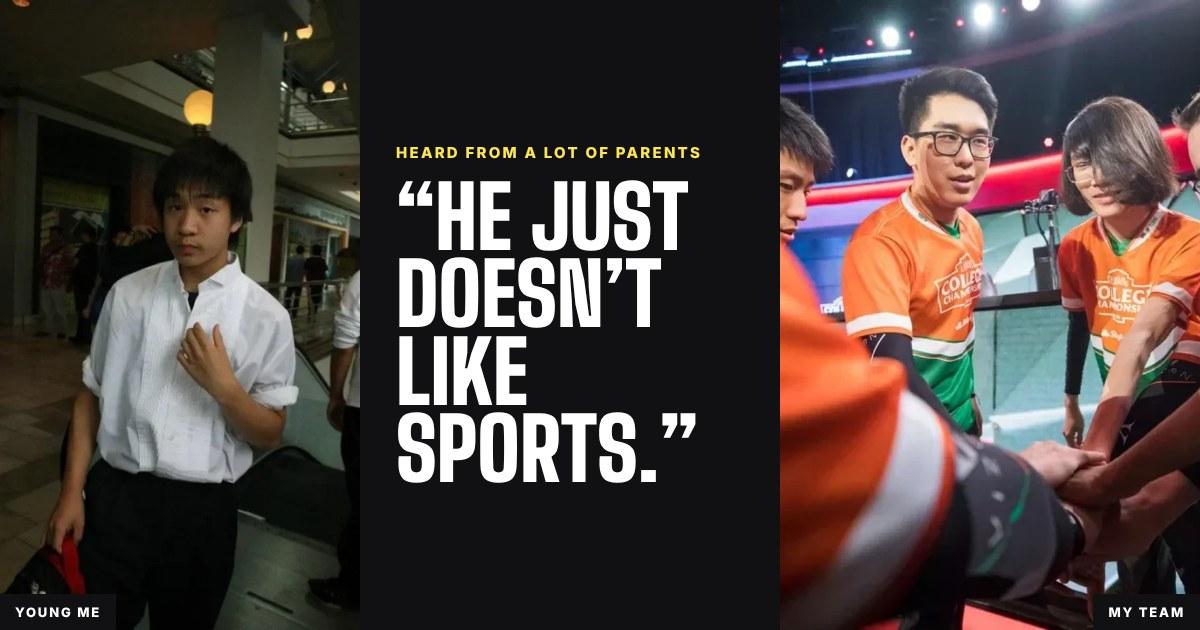
Yes, but probably not what you'd initially guess. Earlier this year, a player who goes by lei posted an essay on X called "how to get good (at video games, then everything else)." lei has hit about top 700 in North America in both League of Legends and Teamfight Tactics, which is roughly the top 0.1%. The essay's point is that the rank was never the valuable part. In lei's words, the rank is "the receipt that proves you know how to get good."
That's a big claim, so here's why it holds up. A rank is public and hard to fake. The game keeps matching you against people approximately as good as you are, so the only way up is to actually get better. Nobody hands you a syllabus. You lose a lot along the way, and progress isn't linear.
Employers have started to notice. Susquehanna, a large trading firm, runs a recruiting page for chess players and uses poker to teach new traders how to make decisions with incomplete information. In 2019, Shopify's CEO offered a retired StarCraft pro an engineering internship on the strength of his gaming career, arguing it was harder to go pro than to earn a degree. In a June 2026 Harris Poll for Logitech, 82% of IT hiring leaders said they're more likely to consider a candidate who lists gaming on their resume.
Some founders now say it outright. In September, the co-founder of Backboard.io, an AI startup, told players to put their peak rank on their resume in one line: the game, the rank, and how long it took.
What is the improvement loop?
It's five stages, and a kid runs through them for every small piece of a game. Four of them come from a learning model usually credited to Noel Burch at Gordon Training International in the 1970s, though its exact origins are disputed. lei added the third step, deliberate correction, because noticing a mistake isn't the same as fixing it.
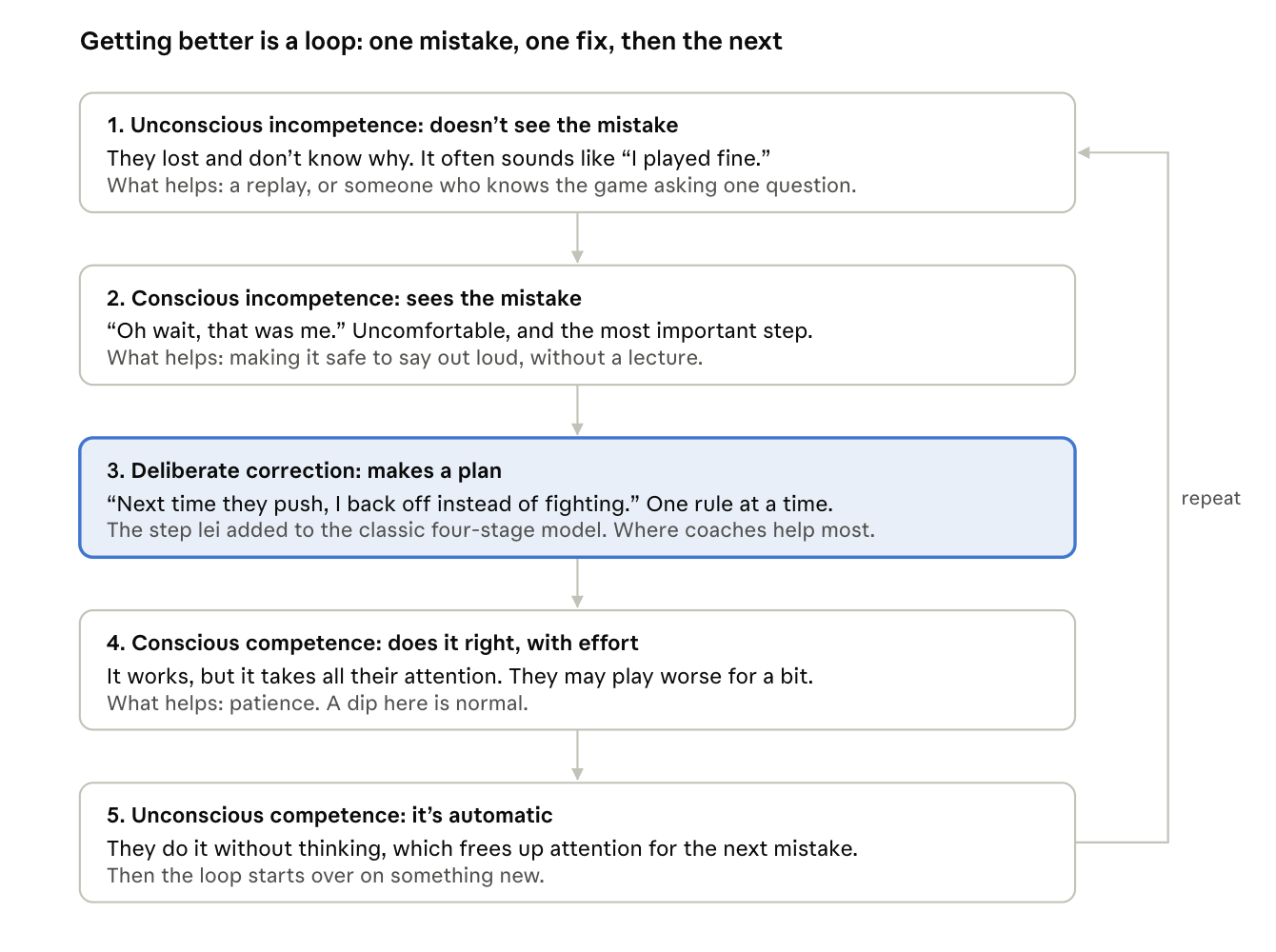
The plan is the step that matters most. Saying a play was bad teaches nothing. Saying what you did, and what you'll do instead the next time that situation comes up, is something a kid can practice.
This lines up with decades of research on expertise. Psychologist Anders Ericsson found that experts improve through what he called deliberate practice: a specific goal, full focus and feedback, often from a coach. More hours of the same thing isn't it.
No single fix makes a kid great. One fewer bad decision per game, one matchup they understand that others don't, multiplied across hundreds of small things, is how the gap opens. That's also why they should work on only one or two things at a time.
Where do kids get stuck?
Most kids stall in the first three stages, and each one sounds different from the kitchen.
Stuck at stage 1: "I played fine." The kid never considers that they were wrong. Usually it's pride, and sometimes it's protection. If losing feels like proof they're bad, it's safer not to look.
Stuck at stage 2: "My team was trash." They know something went wrong, but they pin it on the wrong thing, usually a teammate. Sometimes the teammate really was the problem. But a kid who blames the team every game has stopped learning. I wrote about this pattern in what your kid's gaming is telling you: a skilled kid who's stuck is often asking for coaching without knowing it.
Stuck at stage 3: "I watched a video and it didn't work." They found the right problem, but the fix is wrong. Maybe the advice came from a creator who has never played at the level the kid is trying to reach. Maybe they're trying to fix five things at once.
None of these is a character flaw. Each one is a spot where a kid needs a person who knows the game to ask a better question.
How can I tell if my kid is getting better or just playing?
A kid in the loop names one small thing: "I'm trying to stop chasing kills when I'm low on health." They can tell you about a mistake without blaming anyone. They watch a few players who are better than them, and they can say what those players do differently.
A kid who's just playing says "nothing" or "winning." Every loss is someone else's fault. They play the same way they did a month ago, only more of it.
The third question matters more than it sounds. Watch what they do, figure out why it works, then run it through the loop until it's yours. Kids already do this with creators on YouTube. The skill is picking who to learn from, and not copying blindly.
Neither answer is a verdict on your kid. It tells you where in the loop they are, and what kind of help would move them.
Does any of this carry over outside the game?
Not on its own. lei's essay ends on this point (and I hard agree): getting good at the game was never the valuable skill, and learning how to get good at things was. The problem is players (and especially kids) don't automatically see that the loop they run in a game is the same one they can run at school, at work, or anywhere else. Someone has to name it.
The easiest way is to use the same words at home. When your kid figures out a new strategy, ask how they figured it out. When a math test goes badly, ask the stage 3 question: what exactly went wrong, and what will you do differently next time?
Practice also isn't the whole story. A 2016 review of sports research found deliberate practice explained about 18% of the differences in performance between athletes, and about 1% among elite athletes. The loop is how a kid gets better than they were. It doesn't promise any rank.
Where does a coach fit?
A coach is most useful at stage 3. Most kids can tell when they've made a mistake. Turning a mistake into a plan that actually works is the hard part, and it's where most players stall. A good coach also asks the stage 1 question a kid won't ask themselves, and is the better player worth stealing from.
A team helps too. With the same teammates every week, a kid can't blame strangers, and their mistakes show up in the next practice where someone can help with them.
Season 01, our coached team season, puts kids 9 and older on teams of five with the same coach and teammates all season. They practice online twice a week for 90 minutes, and the season builds to a tournament in the spring. They play League of Legends, and most kids start from scratch. Every practice ends with a review: what went wrong, why, and the one thing each player is working on next.
We also have a free beta in a couple weeks. Check it out at the link below!
Common questions
Do video games teach kids anything?
They can teach a kid how to get better at something: notice a mistake, figure out why, pick something different, and practice until it's automatic. Whether your kid is learning that shows up in what they say after a game, not in how many hours they play.
How can I tell if my kid is improving or just playing more?
Ask what they're working on. A kid who's improving names one small thing, can describe a mistake without blaming anyone, and watches better players. A kid who's just playing says "nothing" or "winning," blames every loss on someone else, and plays the same way they did a month ago.
Does getting good at a game help at school?
Not on its own. Kids don't automatically see that the loop they run in a game works for a test or a sport. It helps when a parent or coach names it, for example by asking after a bad test what went wrong and what they'll do differently next time.
How much does practice explain how good a kid gets?
Less than people think. A 2014 meta-analysis found deliberate practice explained about 26% of the differences in performance in games and 18% in sports, and a 2016 review of sports research found about 1% among elite athletes. Practice is how a kid gets better than they were. It doesn't promise a rank.
What does a gaming coach actually do?
Mostly helps a kid turn a mistake into a plan that works, the step where most players stall. A good coach also asks the question a kid won't ask themselves ("what did you do there?") and is a better player worth learning from.
What is the conscious competence model?
A four-stage model of learning a skill, usually credited to Noel Burch at Gordon Training International in the 1970s: you don't see the mistake, you see it, you can do it with effort, then it's automatic. The player lei added a fifth step in the middle, deliberate correction, for making a plan.
Sources
- lei (@ujustgotleid), "how to get good (at video games, then everything else)," X, September 29, 2026. https://x.com/ujustgotleid/status/2104987306285552038
- Susquehanna International Group, "Chess Players: Use Gaming Skills in Your Career." https://sig.com/chess/
- MONTCO.Today, on Susquehanna teaching new traders poker, September 2024. https://montco.today/2024/09/susquehanna-international-traders-poker
- Business Insider, Shopify's CEO offers retired StarCraft 2 pro Ryoo "SeleCT" Kyung Hyun an engineering internship, October 2019. https://www.businessinsider.com/retired-gamer-offered-internship-for-past-starcraft-2-performance-2019-10
- Businessballs, "Conscious Competence Learning Model" (history and disputed origins of the model). https://www.businessballs.com/learning-and-behaviour-styles/conscious-competence-learning-model/
- Logitech, "The Gamer IT Leader: How Video Games Are Reshaping Enterprise Tech, Hiring, and Strategy," August 17, 2026 (Harris Poll of 600 IT decision-makers in the US, UK and Australia, June 2026). https://www.logitech.com/blog/2026/08/17/the-gamer-it-leader-how-video-games-are-reshaping-enterprise-tech-hiring-and-strategy/
- Jonathan Murray, Backboard.io, "I Watched Our Interns Play Valorant for Three Hours. Put Your Rank on the Resume." DEV Community, September 5, 2026. https://dev.to/jon_at_backboardio/i-watched-our-interns-play-valorant-for-three-hours-put-your-rank-on-the-resume-8jd
- Ericsson, Krampe and Tesch-Römer, "The role of deliberate practice in the acquisition of expert performance," Psychological Review, 1993. https://doi.org/10.1037/0033-295X.100.3.363
- Macnamara, Moreau and Hambrick, "The relationship between deliberate practice and performance in sports: a meta-analysis," Perspectives on Psychological Science, 2016. https://doi.org/10.1177/1745691616635591
- Macnamara, Hambrick and Oswald, "Deliberate practice and performance in music, games, sports, education, and professions: a meta-analysis," Psychological Science, 2014. https://doi.org/10.1177/0956797614535810